Everyone Wants Paris. Here's Where 2026's Best Value Trip Is Actually Happening

By EHG
●Published on July 9, 2026
Search interest for Western Europe's big three, London, Paris and Rome, has flattened, while interest in Eastern Europe has surged.
Seven of the ten fastest growing destinations tracked by major flight search platforms in 2026 sit east, Vienna, Prague, Sofia and Krakow among them.
The reason isn't complicated. Airfares to the usual capitals climbed again this year and the crowds at the major landmarks have never been thicker.
For Australians, the timing works in our favour too! New connectivity through hubs like Istanbul, Doha and Singapore has cut the number of legs it takes to reach these cities that were once considered a three flight slog.
What used to be a once in a lifetime add on to a European trip is now a genuine destination in its own right.
These are the cities being quietly booked out and at the end of this list, we'll tell you how EHG members are already going in the draw to win exactly these kinds of experiences.
1. Prague, Czech Republic
Prague has always been beautiful. Long treated as a two night stopover between Vienna and Berlin, Prague is now showing up as a primary destination in its own right, and it's easy to see why once you're standing on Charles Bridge at sunrise before the tour groups arrive.
The Old Town Square, the Astronomical Clock and the castle complex above the Vltava River are all walkable, all centuries old, and almost none of it requires the entrance fees or advance bookings that Western European landmarks now demand.
Beyond the postcard sights, Prague has one of the best value dining and drinking scenes left in Europe.
A serious Czech meal with a local beer, brewed in a country with a stronger claim to inventing the pilsner than almost anywhere else, still costs a fraction of the equivalent in Paris or Amsterdam. Add direct rail connections to Vienna, Krakow and Budapest, and Prague becomes less a single trip and more the anchor for an entire Eastern European itinerary.
Trips like these are exactly what EHG members have already won. Check out our recent winners to see the real people who walked away with holidays like this through the weekly EHG draw.
2. Kraków, Poland
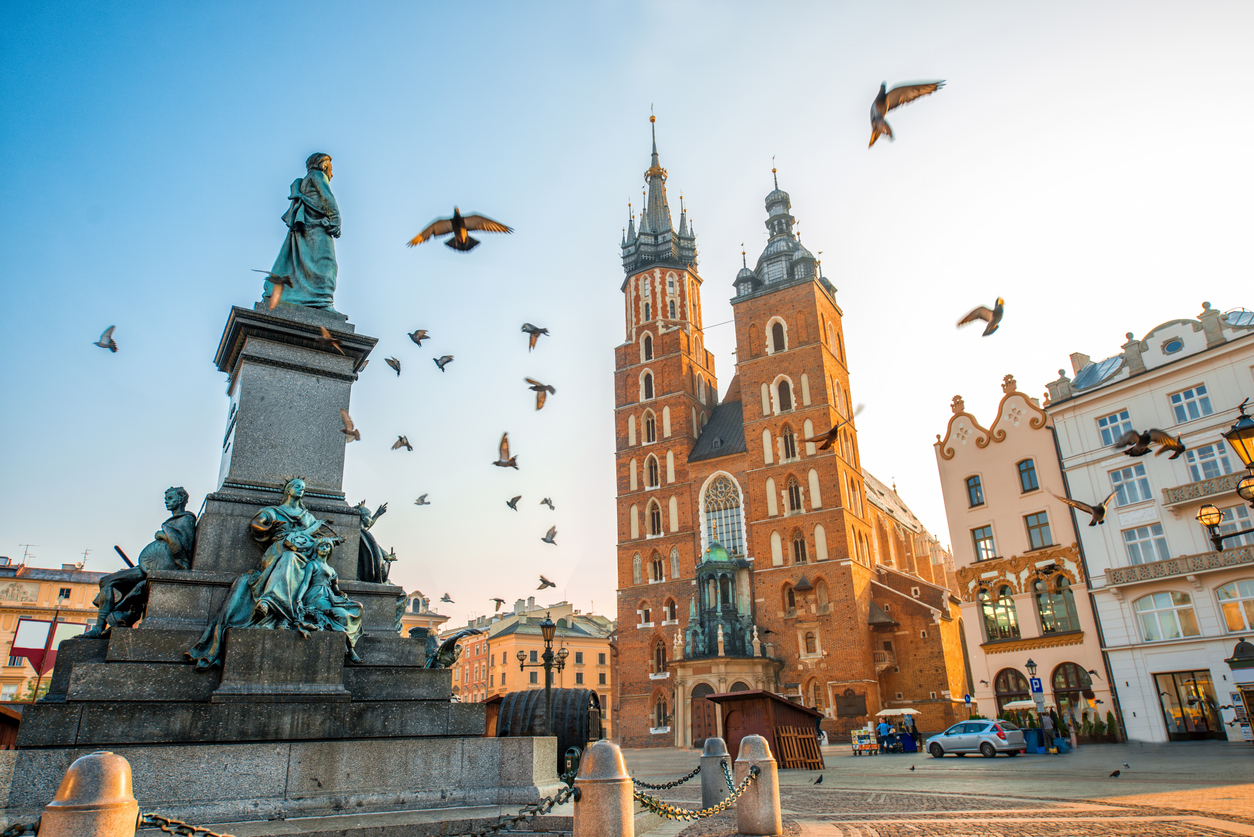
Kraków survived the Second World War with its medieval core almost entirely intact, and the result is one of the largest and best preserved market squares in all of Europe, Rynek Główny, ringed by pastel townhouses, church towers and cafes that spill out onto the cobblestones from spring through autumn. Wawel Castle sits above the Vistula River, and beneath the city itself runs a network of medieval cellars now converted into bars and restaurants.
Kraków also works as a base for two of the most significant sites in modern history. Auschwitz Birkenau is an hour and a half away, and the Wieliczka Salt Mine, a UNESCO World Heritage site with chapels, chandeliers and sculptures carved entirely from rock salt hundreds of metres underground, is closer still. Few cities in Europe combine this much beauty with this much weight.
3. Budapest, Hungary
Split by the Danube into hilly Buda and flat, grand Pest, Budapest has the architecture of an imperial capital and the prices of a country that only joined the EU in 2004.
The Hungarian Parliament Building lit up at night viewed from a river cruise is one of the great sights in Europe. It's rarely mentioned in the same breath as the Eiffel Tower or the Colosseum despite arguably competing with both.
What sets Budapest apart is what sits beneath it. The city is built on more than a hundred natural thermal springs, and bathing at Széchenyi or Gellért, in ornate, steaming outdoor pools surrounded by baroque architecture, is unlike anything else on this list.
Add a ruin bar scene built inside crumbling old buildings in the Jewish Quarter, and Budapest offers day and night experiences that most cities need twice the budget to match.
4. Sofia, Bulgaria
Sofia rarely makes anyone's shortlist, which is exactly why it should be on yours. Mount Vitosha rises directly behind the city, close enough that a morning hike or a winter ski run is a tram ride from the centre, not a day trip. The city itself layers Roman ruins, Ottoman mosques, Orthodox cathedrals and Soviet era architecture within a few blocks of each other, a physical record of every empire that has passed through.
Bulgaria remains one of the least expensive countries in the European Union and Sofia's prices reflect that. A specialty coffee, a full dinner with local wine, and a taxi across town together can cost less than a single main course in central London.
For travellers chasing the best value to experience ratio left on the continent, Sofia is difficult to beat.
5. Ljubljana, Slovenia
Ljubljana is the kind of capital that makes larger cities look like they're trying too hard. The entire historic centre is car free, the Ljubljanica River is lined with cafe terraces, and a dragon guards the bridge that gives the city its symbol and according to legend, its name.
Ljubljana Castle sits on a hill above it all, reachable by a short funicular ride, with views across the Julian Alps on a clear day.
It's also one of the greenest capitals in Europe, consistently ranked among the continent's most sustainable cities, with an old town small enough to fully explore on foot in an afternoon.
Slovenia's Lake Bled, with its island church and cliffside castle, is less than an hour away, making Ljubljana one of the few capitals where a fairytale day trip is genuinely closer than the airport.
6. Zagreb, Croatia
Most Australians who visit Croatia never see Zagreb, flying straight past it to reach Dubrovnik or Split. That's a mistake. Zagreb's Upper Town is a genuine medieval quarter of church spires, red tiled roofs and the striped St Mark's Church, connected to the modern Lower Town by the city's own funicular, one of the shortest AND steepest in the world.
Zagreb has also built a reputation as home to one of Europe's best Christmas markets, but the city works just as well outside the festive season, with a museum dedicated to broken relationships, a thriving cafe culture along Tkalčićeva Street, and access to the Plitvice Lakes National Park, a two hour drive away, where turquoise water cascades through sixteen terraced lakes.
7. Tbilisi, Georgia
This one asks a little more of you, and rewards it accordingly. Tbilisi sits at the crossroads of Europe and Asia, in the foothills of the Caucasus, with a skyline of Soviet apartment blocks, Persian style balconies and a hilltop fortress all within view of each other. The Old Town's sulfur bathhouses have been in continuous use for over a thousand years, and a soak followed by a Georgian feast, built around cheese filled khachapuri and clay oven bread, is reason enough to visit on its own.
Beyond the city, the Kakheti wine region produces wine using an eight thousand year old method involving clay vessels buried underground, a claim to the oldest wine tradition on earth. Tbilisi is the kind of destination that early adopter travellers are quietly exploring right now, before the rest of the world catches on and prices follow.
Before You Go: Pack Smart With Your EHG Member Rewards
A city hopping trip across Eastern Europe rewards travellers who pack light and move fast between train stations and budget flights, and EHG members don't pay full price to get equipped. Through the EHG member rewards platform, members access exclusive discounts across hundreds of retail partners, including savings on luggage, adaptors and travel essentials that add up fast before a multi city trip.
With up to 80% off across 12,000+ retail partners, 5% off at Coles and Woolworths, and 40% off dining, the average EHG family saves around $5,500 a year. That's a meaningful contribution toward the holiday you're working toward. Browse the full rewards library here.
Everyone Else Is Still Booking the Obvious Cities. You Don't Have To.
Most travellers default to the same five European capitals every single trip, then wonder why the photos look exactly like everyone else's. The travellers who've figured it out are already booking the cities that are trending upward right now, while flights are cheaper, crowds are thinner and the value is still genuinely good.
We created EHG because we believed Australians deserved a membership that did three things at once: helped them win extraordinary holidays, saved them real money every day, and gave back to the causes that matter most to them.
Every week, EHG runs a draw where members win luxury holidays, the kind of experiences on this list. Packages worth up to $40,000. 20% of every membership fee goes directly to your chosen charity, from Vision Australia and Beyond Blue to Starlight and Rizeup. See all our charity partners here.
Join EHG, access thousands of everyday savings, support a charity you care about, and go in the weekly draw to win a luxury holiday.
Published July 9, 2026


