Obscure Sporting Traditions Worth Travelling For

By EHG
●Published on September 4, 2026
The sporting traditions that actually make a trip unforgettable and predate stadium sponsorship deals by centuries are the ones worth travelling for!
These are six of them
1. Naadam Festival, Ulaanbaatar, Mongolia
Mongolia's Naadam Festival has roots stretching back centuries, born out of military training exercises; the games nomadic clans played at weddings and religious gatherings.
It became a formal annual event in 1639, held to honour Zanabazar, Mongolia's first Bogd Gegeen (spiritual leader), today it's a national holiday running from 11 to 13 July, recognised by UNESCO as part of humanity's Intangible Cultural Heritage since 2010.
Everything centres on the 'Three Manly Games': wrestling, archery and horse racing, all three still judged more or less the way they were centuries ago.
The wrestling alone draws up to 1,024 competitors into a single elimination bracket, with fighters losing the moment any part of their body other than a hand or foot touches the ground; win enough rounds and you're crowned with a title like 'lion' or 'elephant,' honorifics that stick with a wrestler for life.
The horse races are the real shock for first time visitors: cross country events of 15 to 30 kilometres, ridden not by adults but by children aged five to thirteen who train for months beforehand, with the biggest races sending up to a thousand horses thundering across the steppe at once.
Archers shoot from 75 metres (men) or 65 metres (women) at small cylindrical targets called surs, and the whole spectacle plays out at Ulaanbaatar's National Sports Stadium under a sky full of gers and flags.
2. Palio di Siena, Siena, Italy
The modern Palio dates to 1633, when the Grand Duke of Tuscany redirected the city's competitive energy away from bullfighting (outlawed decades earlier) and into a bareback horse race around the Piazza del Campo.
Seventeen contrade, the historic city wards, still exist but only ten race at a time: seven qualify automatically because they sat out the previous year and the remaining three are chosen by lottery. Two races run every year, the Palio di Provenzano on 2 July and the Palio dell'Assunta on 16 August, and rivalries between certain contrade run so deep that beating a historic enemy matters more than winning outright.
There's remarkably little in the way of rules. Jockeys ride without a saddle, they're permitted to whip rival horses with a dried bull hide crop called a nerbo, and a horse that loses its rider mid race can still win if it crosses the line first, riderless or not. Three laps of the piazza, run over packed earth laid down for the occasion, are usually done in under 90 seconds, and studies covering more than seventy years of racing put the odds of a jockey falling at somewhere above 96 percent.
It is, by a wide margin, the shortest, fastest and most dangerous 90 seconds in Italian sport.
3. Wife Carrying World Championships, Sonkajärvi, Finland
Legend has it the sport traces back to Herkko 'Ronkainen the Robber' Rosvo-Ronkainen, a 19th century Finnish bandit whose gang allegedly abducted food, livestock and women from neighbouring villages, carrying them off on their backs.
A tidier version of the story says he trained his men to be faster and stronger by making them run with heavy sacks slung over their shoulders, and either way, Sonkajärvi turned the legend into an actual sporting event in 1992, opening it to international competitors from 1995 onward.
What started as a local novelty now draws couples from as far as the United States, Hong Kong and India every July.
The course runs 253.5 metres and includes two dry obstacles and a water hazard, all navigated while carrying a partner who has to weigh at least 49 kilograms or wear a weighted rucksack to make up the difference. Nearly every serious team uses the 'Estonian carry,' the wife held upside down with her legs over her partner's shoulders, a technique so dominant that an Estonian pair holds the world record at 56.9 seconds, set back in 2006. Win, and the prize is calculated on the spot: your wife sits on one end of a seesaw while organisers add beer to the other side until it balances, and you take home exactly her weight in it.
4. Camel Wrestling Festival, Selçuk, Türkiye
Camel wrestling grew out of the Yörük, the nomadic herders of Anatolia who relied on camels as pack animals and, inevitably, started competing to see whose was toughest. The tradition traces to the early 19th century in Aydın province, and the modern Selçuk Efes festival, held every January, has become the sport's marquee event, often described as the camel wrestling equivalent of Türkiye's famous Kırkpınar oil wrestling championship. A recent edition drew around 20,000 spectators and more than 160 competing camels.
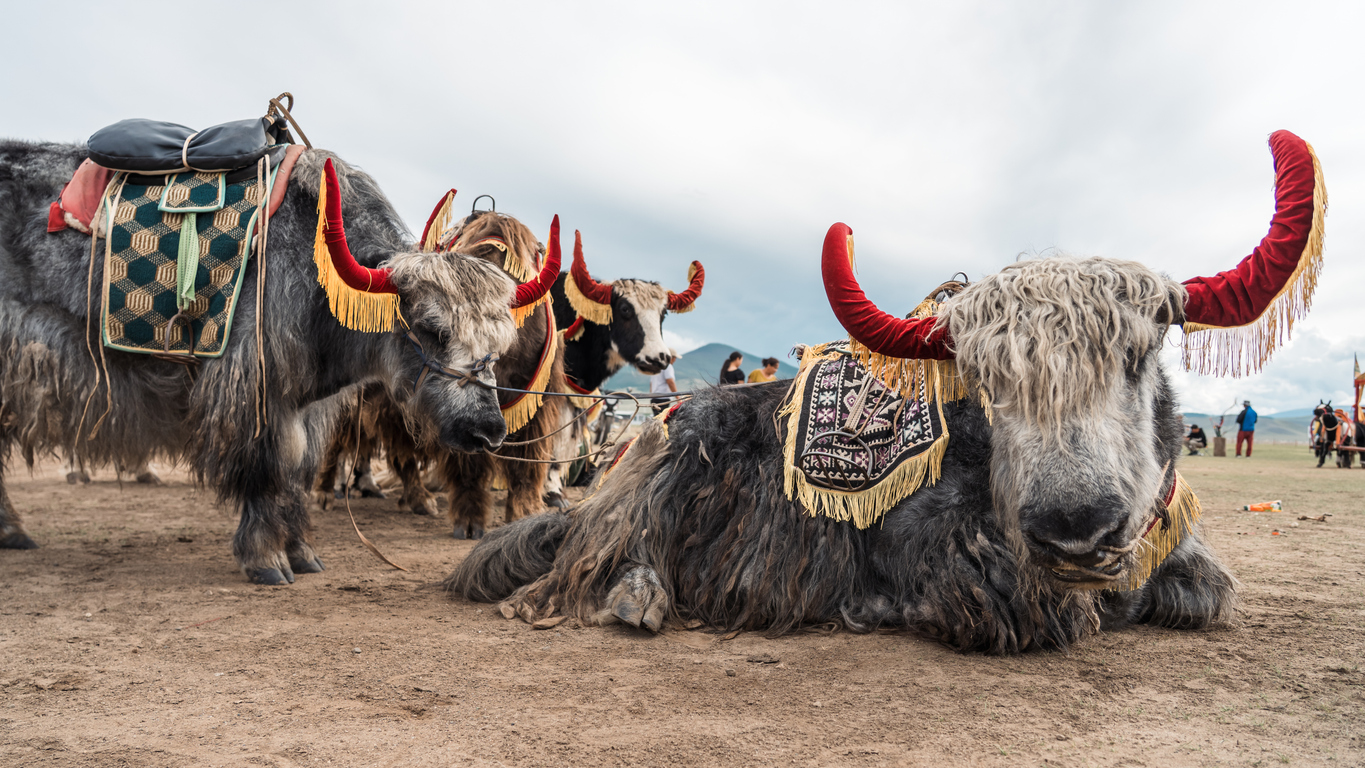
Every animal is a Tülü, a hybrid bred specifically for the ring by crossing a female dromedary with a male Bactrian camel, and matches are split into four weight classes. A camel wins by making its opponent scream, flee or collapse, using not much more than headlocks and body weight, while muzzles and rope held by nearby handlers keep things from turning genuinely dangerous. What makes the day, though, is the parade beforehand: camels dressed in elaborately decorated saddles hung with bells, tassels, pom poms and mirrors, each one a small, walking piece of Yörük folk art before it's ever asked to wrestle.
5. Dambe Boxing, Kano, Nigeria
Dambe has been fought among the Hausa people for roughly three centuries, historically by butchers' guilds who travelled between villages during the harvest season, challenging local fighters for money and reputation. Many of its strikes and stances are said to double as leftover combat training, and the sport still carries that raw, unregulated edge today, largely concentrated around Kano in Nigeria's north.
Fighters wrap one fist tightly in cord and cloth to form a hardened weapon called a kara, while the other hand stays open for defence, and kicks are fair game throughout. Bouts run three rounds with no time limit and end the moment a fighter's knee, hand or any part of their body besides the sole of a foot touches the ground. What sets Dambe apart from most combat sport is the ceremony around it: fighters carry amulets for protection, praise singers call out reputations before the first punch lands, and a live drum line keeps the crowd's energy at a near constant roar.
6. Chilean Rodeo, Rancagua, Chile
Chile's national sport traces back to Spanish colonial cattle musters. Colonial governor García Hurtado de Mendoza, trained in Moorish cavalry arts, ran the earliest gatherings in what's now Santiago's Plaza de Armas, and by 1557 the musters had become mandatory, demanding real horsemanship rather than a casual round-up. The modern half moon arena, the medialuna, arrived in 1860, and rodeo was formally declared Chile's national sport by government decree in 1962, a status that still surprises visitors who assume the honour belongs to football.
Two huasos, Chilean cowboys in wide brimmed hats and ponchos, work together on horseback to pin a young steer against the medialuna's padded wall, with points awarded based on exactly where along the wall the animal is stopped rather than on speed. The Campeonato Nacional de Rodeo, the national championship, runs every April at the Medialuna Monumental in Rancagua, the closest thing the sport has to a grand final, and roughly 320 rodeo events are held across the country each season. In 2004, rodeo drew bigger crowds than professional football matches nationwide, trailing only soccer itself in overall popularity.
Before You Go: Pack Smart With Your EHG Member Rewards
A trip built around any of these still means flights, gear and the everyday spending that comes with travel, and EHG members don't pay full price for any of it. Through the EHG member rewards library, members access exclusive discounts across 12,000+ retail partners, covering everything from travel essentials and clothing to everyday groceries and fuel. With up to 80% off online shopping, 5% off Coles and Woolworths, and 40% off dining, the average EHG family saves around $5,500 a year, a meaningful head start on the next trip.
These Are Exactly the Trips Exclusive Holiday Getaways Was Built For
Most people will never watch a Palio unfold in under 90 seconds or see a camel dressed head to toe in bells and mirrors, not because these events are unreachable, but because finding them takes more than a search engine and a plane ticket.
We built Exclusive Holiday Getaways because we believed Australians deserved a membership that did three things at once: helped them win extraordinary holidays, saved them real money every day, and gave back to the causes that matter most to them.
Every week, EHG members go in the draw to win luxury holidays, the kind of trips that could easily turn into a Naadam grandstand seat or a front row spot at a medialuna, with prizes worth up to $45,000. 20% of every membership fee goes directly to your chosen charity, from Vision Australia and Starlight to WWF and Ronald McDonald House.
See all our charity partners here.
Join EHG: access thousands of everyday savings, support a charity you care about, and go in the weekly draw to win a luxury holiday. The best rivalries don't wait either.
Published September 4, 2026


