Worlds best Swimming Holes

By EHG
●Published on September 17, 2026
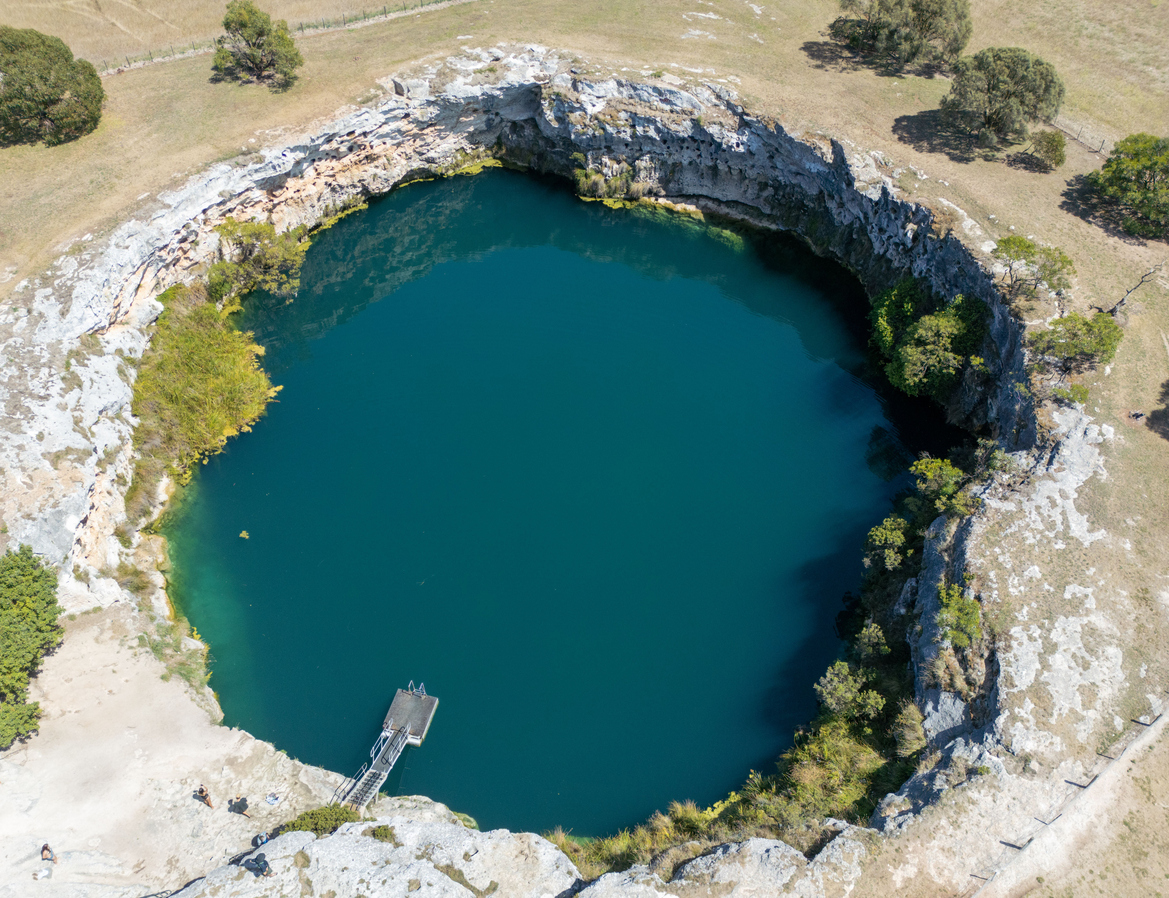
1. Little Blue Lake, Mount Gambier, South Australia
Most people who've heard of Mount Gambier's Blue Lake don't know you can't actually swim in it: it's the town's drinking water supply, fenced off and strictly hands-off.
Fifteen kilometres south, in a quiet paddock between Mount Gambier and the extinct volcano Mount Schank, sits the lake locals actually jump into: Little Blue Lake, a sinkhole formed by a collapsed underground cave, ringed by ten-metre limestone walls and running to roughly 35 metres deep.
There's a pontoon for anyone who'd rather not leap off the ledge, natural rock terraces that work like an amphitheatre for watching everyone who does, and water that turns a genuinely startling shade of blue once the clouds clear.
It sits in South Australia's cave country (the Limestone Coast has around 500 underground caves and 50 sinkholes in total), and it's exactly the kind of trip EHG members are already winning, check out our recent winners to see who's walked away with holidays like this.
Best swum between November and May, before the winter clouds roll back in.
2. To Sua Ocean Trench, Upolu, Samoa
To-Sua means "giant swimming hole" in Samoan, which is undersold if anything. It's a 30-metre-deep sinkhole punched into an old collapsed lava tube, connected to the open ocean through an underground cave at one end, with water so clear the drop looks bottomless from the platform above. The only way in is a steep bamboo ladder lowered into the trench: solid enough to trust, rickety enough that you'll take your time on it.
Once you're down, a rope-assisted passage connects To Sua to a second, smaller trench next door, though the currents through it can run surprisingly strong for a hole in the ground.
It sits on Upolu's south coast near the village of Lotofaga, about an hour from Apia, surrounded by a landscaped garden that makes the whole thing feel more like a discovery than an attraction, which is remarkable given it's Samoa's most photographed site.
3. Hierve el Agua, Oaxaca, Mexico
The name means "the water boils," which is the one misleading thing about Hierve el Agua: the natural infinity pools here are cold, not hot.
What makes them extraordinary is what sits behind them: two "petrified waterfalls," mineral-rich spring water that's been dripping over the cliff edge for thousands of years and calcifying as it goes, the same slow process that builds stalactites, except stretched sideways across a 90-metre rock face.
The pools themselves sit right on the cliff edge, and swimming in them is the whole point: you're floating in genuinely warm-looking turquoise water with nothing but open air and a sheer drop past the rim.
It's about 70 kilometres east of Oaxaca city, roughly an hour by shared colectivo from the town of Mitla along a mountain road with a habit of reminding you exactly how high up you are.
4. Kanto Lampo Waterfall, Gianyar, Bali
Bali's famous waterfalls tend to mean Tegenungan or Tibumana, both worth the trip and both permanently full of people angling for the same photo. Twenty minutes further out, near Ubud in the Gianyar regency, Kanto Lampo cascades down a wide amphitheatre of golden, stepped rock into a shallow natural pool below, the kind of formation that looks landscaped but isn't.
A short, steep path drops you down to the water, where depth ranges from ankle-deep at the edges to chest-deep upstream, making it one of the rare waterfalls on the island genuinely manageable with kids in tow. There's a small bat cave and a second viewpoint across the river for anyone who wants to explore past the main pool, and the rocks are as slippery as they look, so water shoes earn their keep here more than almost anywhere else on this list.
5. Hot Water Beach, Coromandel Peninsula, New Zealand
Hot Water Beach isn't hiding but almost nobody outside New Zealand times their trip right, which is the only thing that matters here.
Ancient volcanic activity heats groundwater to around 64°C directly beneath the sand, and for a two-hour window either side of low tide, that water rises close enough to the surface to dig into.
Hire a spade in nearby Hahei or Whitianga, pick your patch of sand, and dig your own thermal pool a few metres from the surf, mixing in cold seawater until it's bearable. Miss the tide window and it's just a beach; get it right and you've built a private hot tub with an ocean view. It sits on the Coromandel's east coast, about thirty minutes south of Whitianga on State Highway 25.
6. Devil's Pool, Victoria Falls, Zambia
This is the one for anyone who found the rest of the list a bit tame. Devil's Pool sits on the lip of Victoria Falls itself, on the Zambian side near Livingstone Island, separated from a hundred-metre drop by nothing but a natural rock ledge and the Zambezi's seasonal low flow. Guides swim strong swimmers across the current to reach it; weaker swimmers can wade in from the island.
It only exists for part of the year (accessible from around June to December, genuinely safe for swimming roughly mid-August through December once the river drops low enough), with October and November the most reliable months.
Before You Go: Pack Smart With Your EHG Member Rewards
A trip built around water like this still means swimwear, reef-safe sunscreen, water shoes and a dry bag for anything you don't want soaked, and EHG members don't pay full price for any of it. Through the EHG member rewards library, members access exclusive discounts across 12,000+ retail partners, covering everything from travel essentials and clothing to everyday groceries and fuel. With up to 80% off online shopping, 5% off Coles and Woolworths, and 40% off dining, the average EHG family saves around $5,500 a year, a meaningful head start on the next trip.
These Are Exactly the Trips Exclusive Holiday Getaways Was Built For
Most people will never float in any of these pools, not because they're unreachable, but because getting there takes more than a search engine and a credit card.
We built Exclusive Holiday Getaways because we believed Australians deserved a membership that did three things at once: helped them win extraordinary holidays, saved them real money every day, and gave back to the causes that matter most to them.
Every week, EHG members go in the draw to win luxury holidays (the kind of trips on this list) with prizes worth up to $35,000, and quarterly mega-prizes reaching $100,000. And 20% of every membership fee goes directly to your chosen charity: from Vision Australia and Beyond Blue to WWF and Starlight Foundation.
Published September 17, 2026


